New pieces added regularly — follow us on Facebook & Instagram

The Plants Behind the Magic
Every terrarium that leaves this studio is planted with purpose. The plants you see here are the ones I grow, propagate, and use most — chosen for how they perform in FNQ conditions, in the particular microclimate of a closed or semi-closed glass world.
These are not plants I've ordered from a catalogue. They are grown here, in Cairns, propagated by hand. The moss is never taken from the wild. What you get in one of my terrariums is a living system built from plants that have already proven themselves in this climate.
That said — terrariums have their own rules, and even the hardiest plant can struggle when conditions aren't right. This guide tells you what to expect, what to watch for, and what to do when something goes wrong.
Not every plant listed here will be in your terrarium — what goes in depends on the build, the brief, and what suits the ecosystem being created. But if you're curious about a plant you can see, chances are you'll find it here.
Ferns
Ferns are among the most rewarding terrarium plants — and among the most misunderstood. They love humidity, indirect light, and consistent moisture. They do not love being touched repeatedly, moved constantly, or having waterlogged roots.
In FNQ's natural humidity they often thrive with very little intervention. Inside a terrarium, they have everything they need — as long as the balance is right.
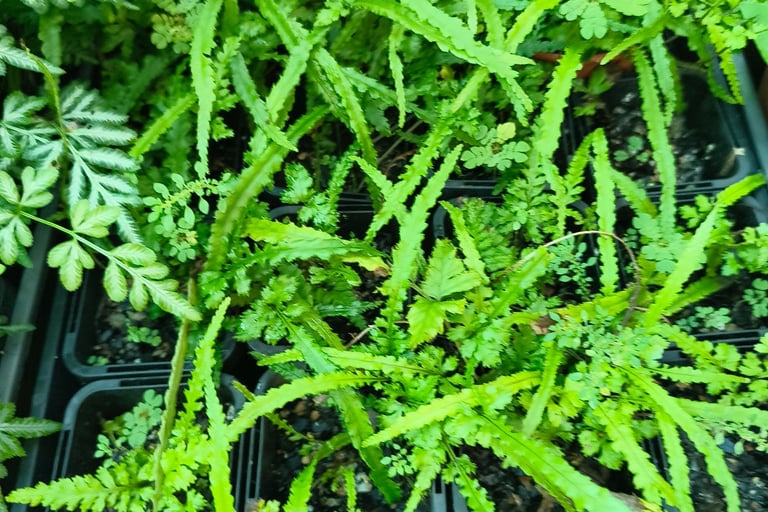
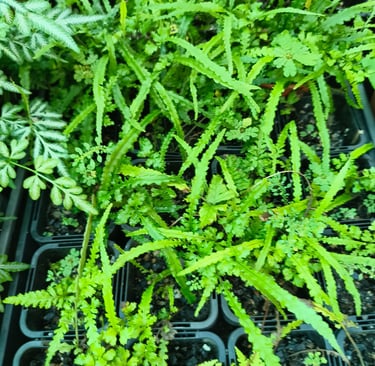
Plants in this group: Maidenhair Fern (Adiantum sp.) · Nephrolepis 'Duffii' · Nephrolepis 'Cotton Candy' · Bolbitis sp. 'Gua Angin'
·Pteris ensiformis 'Evergemiensis 'Silver Lace Fern· Nephrolepsis Emina · Pteris ensiformis 'Slender Brake Fern'
In the terrarium: Ferns love the stable humidity of a closed or semi-closed terrarium. They grow toward indirect light, soften hardscape beautifully, and fill space without competing aggressively. Cotton Candy has a feathery cloud-like texture; Duffii stays compact and tidy; Maidenhair cascades; Bolbitis Gua Angin — converted from aquatic growth — anchors dramatically to wood and rock.
What can go wrong:
Fronds going brown or black at the tips is the first warning. Full blackening of fronds usually means the air has dried out, the plant has been handled repeatedly, or there has been a sudden temperature or humidity shock. Yellowing fronds generally mean too much direct light. Mushy or collapsing fronds at the base mean the roots are waterlogged.
Quick fix:
Remove blackened fronds cleanly — they will not recover. Increase ambient humidity. Do not mist directly onto fronds. Ensure drainage is working. Move away from direct light if yellowing. For Bolbitis Gua Angin specifically, keep substrate consistently moist — as a converted aquatic plant it is more sensitive to dry periods than other ferns.
Note: Cotton Candy fern is propagated here in the studio and is not always commercially available. Bolbitis sp. Gua Angin is an aquatic fern successfully and fully converted to terrestrial growth — a genuinely unusual inclusion.
Moss
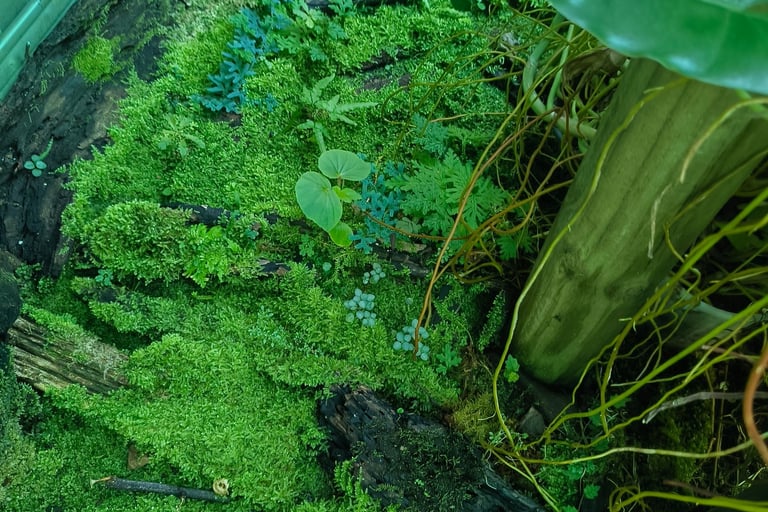
Moss is the foundation of most builds. It regulates moisture, creates the living floor of the ecosystem, and looks extraordinary when it takes hold. All moss used in Garden, Gifts & Glass terrariums is propagated — never taken from the wild.
Plants in this group: Cushion Moss · Sheet Moss · Various propagated FNQ species
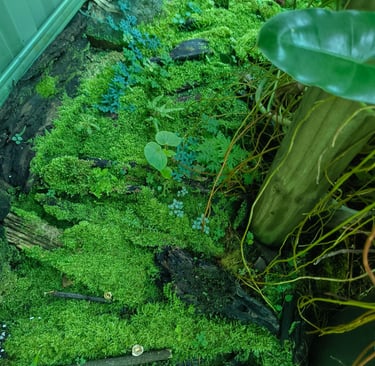
In the terrarium: Moss creates the forest floor. It holds moisture, softens hardscape, and provides a living surface for other plants to push through. It is the element that makes a terrarium feel truly alive.
What can go wrong:
Moss turning brown or black is almost always a moisture issue. Brown patches with a slimy texture mean excess water and poor drainage. Dry, papery browning means it has dried out. Moss that goes grey-green and flat has usually been overheated — often by direct sun hitting the glass.
Quick fix:
Check drainage first. If rotting — reduce watering and improve airflow. If drying out — mist lightly and check the seal on closed terrariums. Never place a terrarium in direct sunlight.
Note: All moss provided in our terrarium's is grown and seeded onto logs in our greenhouse — never wild-harvested.
Selaginella
Selaginella sits somewhere between a moss and a fern — ancient, structural, and visually extraordinary. It creates texture and depth that nothing else quite replicates. In FNQ's natural humidity it can grow vigorously; inside a terrarium it is one of the most rewarding plants to watch establish.
Plants in this group: Selaginella sp. — Teal/Blue-Green form · Selaginella 'Golden Carpet' · Uncinata 'peacock fern'· Erythropus 'Ruby Red"
In the terrarium: Selaginella spreads as a ground cover, climbs gently over rocks and wood, and creates incredible colour contrast. The teal form has an almost metallic quality in indirect light. Golden Carpet warms the palette beautifully against deeper greens.
What can go wrong:
Yellowing or bleaching means too much light. Browning and collapse means it has dried out — Selaginella can go from healthy to crispy surprisingly fast if humidity drops. Leggy, stretched growth in Golden Carpet means it needs slightly more light.
Quick fix:
Keep humidity high. Indirect light only. If it collapses from drying out, mist around the plant and seal the lid for a day or two — it can sometimes pull back from the edge. Golden Carpet needs marginally more light than the teal form.
Ground Covers & Creepers
These are the plants that fill space, trail over edges, weave between structures, and give a terrarium its sense of wildness and depth. Most are fast-establishing in FNQ conditions.
Plants in this group: Baby Tears (Soleirolia soleirolii) · Hydrocotyle sibthorpioides · Ficus pumila 'Minima' / Frog Vine
In the terrarium: Baby Tears creates a lush carpet effect that softens everything it touches. Hydrocotyle trails delicately between other plants and produces tiny white flowers in a well-established build — a lovely surprise. Frog Vine climbs wood, glass, and hardscape beautifully; the tiny leaves genuinely do look like little frogs clinging to surfaces — once you see it, you can't unsee it.
What can go wrong:
Baby Tears goes black when overwatered or sitting in stagnant water, and can melt if the terrarium overheats in direct sun. Hydrocotyle stretches and goes leggy without enough indirect light. Frog Vine drops leaves or yellows with cold stress or overwatering, and won't climb well if the environment is too dry.
Quick fix:
Ensure drainage is working for Baby Tears — trim any blackened sections and it will regrow. Keep Hydrocotyle in bright indirect light. Maintain warmth and humidity for Frog Vine; reduce watering frequency if leaves are yellowing.
Foliage Plants
These are the plants that bring colour, pattern, texture, and personality to a build. Most are chosen for how they look at close range — terrariums are intimate objects, and detail matters.
Plants in this group: Fittonia (Fittonia albivenis) · Jewel Orchid (Ludisia discolor) · Begonia 'Bright Eyes' · Begonia boweri (Eyelash Begonia) · Peperomia 'Paradisian Midnight' · Peperomia prostrata 'Silver Dollar' · Pilea 'Bathroom Bubbles' · Spathiphyllum — petite form · Chlorophytum bichetii · Biophytum sensitivum (little tree plant) · Selaginella — Golden form (also listed under Selaginella)
In the terrarium: Fittonia is the signature terrarium plant — intricately veined leaves in pink, red, and white that look extraordinary at close range. Jewel Orchid adds deep, velvety drama. The begonias bring pattern and texture. Peperomias are slow, reliable, and beautiful — the Silver Dollar trails delicately over hardscape. Pilea Bathroom Bubbles adds tactile interest. The petite Spathiphyllum provides clean structure without dominating. Chlorophytum bichetii gives graceful linear texture — it looks like a spider plant but behaves itself and won't outgrow the space. And Biophytum sensitivum — the little tree plant — moves when you touch it. Genuinely.
What can go wrong:
Fittonia droops dramatically when thirsty — but can also droop from root rot (overwatering). Pale or washed-out Fittonia leaves mean too much light. Peperomias store water in their leaves and rot quickly if overwatered — mushy stems are the warning sign. Begonias in enclosed spaces can develop powdery mildew if airflow is poor. Jewel Orchid hates waterlogged substrate. Mimosa pudica needs more light than most terrarium plants and will go leggy in low light.
Quick fix:
For drooping Fittonia — check whether the substrate is dry (water gently, it recovers within hours) or soggy (improve drainage). For Peperomias — reduce watering immediately if stems feel soft. For begonias — improve ventilation and remove any affected leaves; never mist directly onto foliage. For Jewel Orchid — ensure excellent drainage and let the substrate approach dryness between waterings. For Mimosa — move to a brighter position or a semi-open build near a bright window.
Note: Chlorophytum bichetii is often mistaken for a spider plant but is a distinct species that stays compact — an important distinction for terrarium use. Mimosa pudica is a wonderful plant for curious visitors — touch the leaves and watch them fold closed.
Specialty Plants and Builds
The following plants appear only in specialty or statement terrariums and paludariums — builds created with a specific vision, particular conditions, or a more advanced ecosystem in mind. They are not standard inclusions and are not always available. Many of these are aquatic plants that have been converted to terrestrial growth — a process that takes years of patience, repeated propagation, and careful conditioning. There are no shortcuts. What you see here represents years of work to bring these plants to a point where they can thrive on land.
🌿
For those who take this hobby seriously — who understand that a truly extraordinary terrarium is built from truly extraordinary plants — these are worth seeking out. Once you discover what a converted aquatic plant does inside a terrarium, there is no going back. Fair warning - this is where the obsession begins.
Plants in this group: Saxifraga tashiroi (rare) · Eleocharis acicularis 'Mini' — converted from aquatic · Micranthemum 'Monte Carlo' — converted from aquatic · Schismatoglottis sp. Thailand Anubias 'Gold Mini' · Anubias nana 'Petite' (Rare) · Anubias 'White' · Anubias (standard) · Anubias 'Panda' · Anubus Gold · Bolbitis sp. 'Gua Angin' — also listed under Ferns. I have also converted - Bucephalandra 'mini Catherineae & 'Brownie Phantom Mini' ,as well as, Cardemine Japonica Var.
In the terrarium: These plants are chosen for statement builds where the brief calls for something beyond the standard palette. The aquatic conversions — Eleocharis 'Mini' (hair grass) and Micranthemum 'Monte Carlo' — bring a lushness and texture rarely seen in terrestrial terrariums. Saxifraga tashiroi is rare and refined. Schismatoglottis Thailand is unusual and structural.
What can go wrong:
Converted aquatic plants need consistently moist (not waterlogged) substrate and high humidity — they are more sensitive to dry periods than plants that have always grown terrestrially. Saxifraga tashiroi is sensitive to overwatering and poor drainage. All specialty plants require stable conditions.
Quick fix:
Maintain very high humidity for converted aquatics. Ensure drainage is excellent — they need moisture at the roots but not stagnation. For Saxifraga, err on the side of dryness rather than excess water. If in doubt, do less.
NOTE: These plants reflect years of experimentation with aquatic-to-terrestrial conversion. They are technically demanding and visually extraordinary when established. These are specialist builds — not typically available in the terrariums I sell, however available by commission or conversation.
A Word About Buying Plants for Your Terrarium
Just because a plant is labelled "terrarium friendly" or "terrarium plants" doesn't mean it is.
Many plants sold as terrarium suitable by large retail chains are commercially grown interstate under very different conditions — selected for shelf appeal rather than performance inside a closed ecosystem. They may be too large, need more light than a terrarium provides, or simply rot in the very humidity they're supposed to thrive in.
Do your research before you buy. A label is not a guarantee.
Lastly...
Many of the plants listed here are available to take home — subject to what's currently growing and what's ready to leave the greenhouse. Stock changes with the seasons, with what's propagating, and occasionally with what I've decided I'm too attached to part with. The plants on this page have been grown, propagated, and proven here in FNQ.
The research, the failures, the learning and losses of many plants over time to understand the plants that thrive in terrariums in FNQ conditions — that's already been done for you.
If something has caught your eye, get in touch — I'm happy to chat.
Thank you for visiting. These worlds are made from nature, imagination, and many quiet hours of creating.
Quicklinks
Legal
© 2026 Michelle Lam/Garden, Gifts & Glass. All rights reserved.
Designed by Digital Reef Solutions